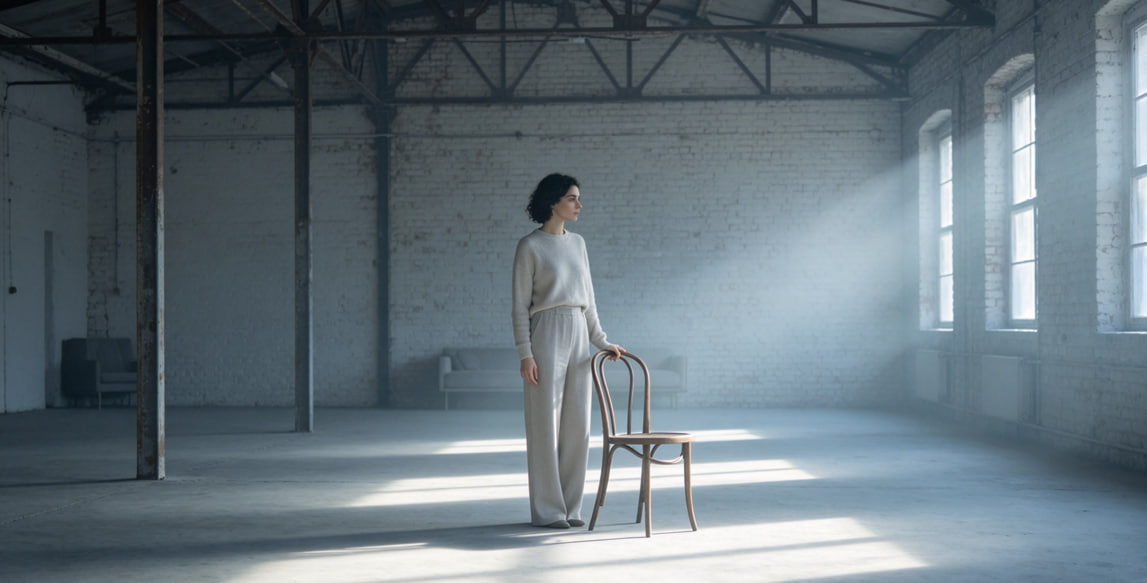
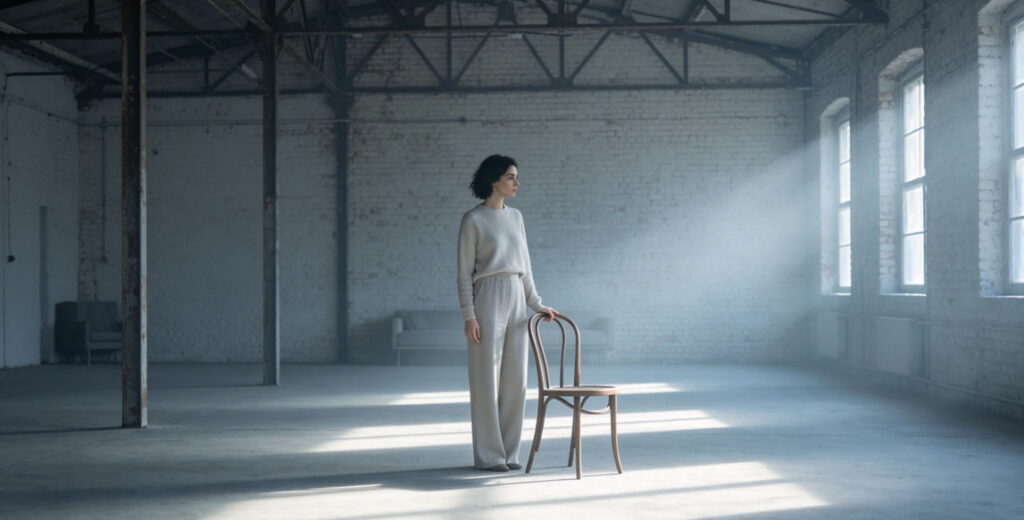
There is a type of movement that does not tell a story – it becomes the story. I recently discovered a modern dance video titled “Folds of the Invisible”, choreographed and performed by Alia Renée, filmed entirely in a deserted industrial loft in Berlin. The space is bare: cracked concrete floors, a single window with grey light filtering through, and a wooden chair placed off‑center. No music, at first. Only the sound of breathing, footsteps, and the distant hum of the city. Within two minutes, I forgot I was watching a screen. I was inside her skin.
The Video: Movement as Raw Material
The video opens in silence. Alia Renée is wearing loose grey pants and a sleeveless white top – ordinary clothes, not a costume. She stands still for ten seconds, her eyes closed. Then her right foot slides forward an inch, then back. The gesture is tiny, almost hesitant. It reminds me of a person testing the temperature of bathwater. She repeats the motion, each time a little larger, until her whole body begins to sway like a tree in a gentle wind.
At 0:45, the first sound appears: a low electronic drone, barely audible, like the hum of a refrigerator in an empty apartment. Alia’s hands rise to her face. She covers her eyes, then pulls her fingers down her cheeks slowly, as if melting. Her torso follows, folding forward from the waist until her head hangs below her heart. She stays there, breath audible, while the drone grows louder and a second layer of sound – a soft, repeating piano note – enters.
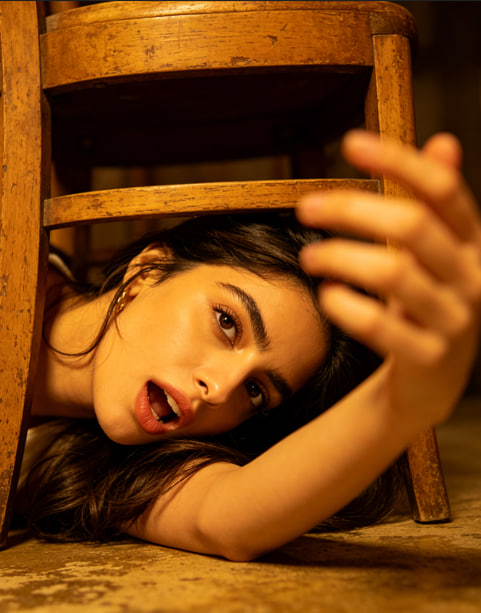
What strikes me about this modern dance video is the absence of “steps”. There are no pirouettes, no grand jetés, no obvious patterns. Instead, every movement seems to emerge from an internal impulse. When she drops suddenly to the floor, it is not a planned fall; it looks like a surrender. When she crawls toward the chair, her spine undulating like a caterpillar, it feels less like choreography and more like a dream unfolding.
Modern Dance: Breaking the Frame
I grew up thinking that dance required beauty – pointed feet, straight lines, graceful arms. Modern dance taught me otherwise. Born as a rebellion against ballet’s rigidity, modern dance embraces gravity instead of defying it. It allows the body to be awkward, heavy, angular, and even ugly. In “Folds of the Invisible”, Alia spends nearly a minute just twitching. Her shoulder jerks, her hip spasms, her fingers flutter uncontrollably. If I saw this on the street, I might think she was having a seizure. But in the context of the video, it becomes a powerful statement about the involuntary movements of anxiety – about the ways our bodies betray what our minds try to hide.
The philosopher Maurice Merleau‑Ponty wrote that we do not have bodies; we are bodies. Modern dance takes this idea literally. When Alia leans so far to the side that she should fall, but her foot catches her at the last moment, I feel a jolt in my own core. When she presses her forehead against the cold concrete and stays there for a full eight seconds, I remember what it feels like to be exhausted – not physically, but emotionally. The video becomes a mirror. Her body becomes a proxy for mine.
At the 3:22 mark, something remarkable happens. She finally sits on the wooden chair – but not normally. She straddles it backwards, facing the chair’s back, and wraps her arms around it like a child hugging a tree. Then she begins to rock. Slowly at first, then faster. The chair creaks. Her breathing becomes ragged. The electronic drone swells into a wall of sound. For a moment, I think she will tip over. But she doesn’t. She stops abruptly, opens her eyes, and looks directly into the camera. The drone cuts out. Silence. She blinks once, twice, and then her face breaks into a small, tired smile.
What I See in Her Movement: A Personal Inventory
I have watched “Folds of the Invisible” seven times now. Each viewing surfaces a different memory. The first time, I thought about loneliness – the way Alia wraps herself around the chair reminded me of nights in my first apartment after a breakup, hugging a pillow because there was no one else to hold. The second time, I thought about creativity – the way she falls and rises, falls and rises, seemed to mirror the process of writing: you put words on a page, you hate them, you delete them, you start again. The third time, I thought about my father.
My father is not a dancer. He is a retired engineer who spends his days in a recliner watching news channels. But last year, I watched him stand up too quickly, lose his balance, and stumble sideways into the kitchen counter. He caught himself, laughed it off, but for two seconds his body was completely honest: it showed fear, vulnerability, and the desperate will to survive. That stumble was pure modern dance. It had no choreography, no audience, no meaning except the meaning I gave it later. Alia’s video gives me permission to see my father’s stumble as beautiful.
Modern dance, I realize, is not about learning moves. It is about unlearning the masks we wear. We spend our lives controlling our bodies – standing straight, hiding our bellies, suppressing yawns, forcing smiles. Then a dancer like Alia Renée comes along and shows us what happens when control is released. The twitches, the falls, the awkward angles – these are not mistakes. They are truths.
The Intimacy of the Dance Video Format
Why does this work better as a video than as a live performance? I have thought about this while watching the final minute of “Folds of the Invisible”. In a theatre, I would be seated twenty or thirty feet away, surrounded by other people. I might cough. Someone’s phone might buzz. The distance would protect me from the dancer’s sweat, her trembling, the small sounds of her breath. But in this video, the camera moves to within inches of her skin. I see the fine hairs on her forearm rise. I see a drop of sweat roll from her temple down to her jaw. I see the micro‑flinch of her eyelid.
This intimacy changes the relationship. Watching a dance video alone in a room, I am not a spectator; I am a confidant. The dancer is not performing for me; she is allowing me to witness something private. The video format also allows me to rewatch, to pause, to rewind, to study. A live performance is a river – you can only see it once, as it flows past. A dance video is a lake. You can circle it, dive into it, sit on its shore for as long as you like.
Dancing the Invisible
The title “Folds of the Invisible” appears only in the video’s description. I did not notice it until my fourth viewing. What are these folds? I think they are the hidden layers of our inner lives – the grief we do not speak, the joy we do not show, the fear we dress up as anger. Alia’s body folds and unfolds throughout the video. She curls into a ball, then stretches out long. She wraps her arms around herself, then flings them open. Each fold reveals something that was previously hidden, like turning the page of a diary.
In the final shot, she walks toward the window and presses her palms against the glass. The camera is behind her, so we see only her back and the reflection of her face – ghostly, transparent. She stands there for a long time. The drone returns, but softer now, like a heartbeat slowing down. Then the screen fades to black. I am left sitting in my chair, my own hands resting on my knees, my own breath slow and deep.
I stand up. I walk to my own window. I press my palms against the cold glass. I am not dancing. But for a moment, I feel the invisible folds inside me – the ones I hide from everyone, even myself. And I think: maybe that is enough. Maybe the purpose of art is not to teach us something new, but to remind us of what we already know but have forgotten how to feel.
Conclusion: An Invitation to Watch Differently
If you have never watched a modern dance video, I invite you to find one – not on a tiny phone screen, but on a laptop or television, with good headphones. Do not try to “understand” it. Do not ask what it means. Instead, ask what it feels like in your own body. When the dancer falls, do your knees weaken? When she breathes, do your own lungs expand? When she stares into the camera, do you look away – or do you stare back?
“Folds of the Invisible” changed how I see movement. Now, when I walk down the street, I notice the subtle choreography of strangers: the woman who hugs her purse like a shield, the man who swings his arms too wide, the child who skips for no reason. We are all modern dancers, improvising our way through a world that rarely watches. But every once in a while, someone films it – and we remember.
End of article.
Note: To complete this post, insert 3–4 images matching the descriptions in brackets. Recommended sources: royalty‑free modern dance photography (e.g., Pexels, Unsplash) or stills from a public‑domain or Creative Commons dance video. Always credit the choreographer, dancer, and videographer if using specific copyrighted material.